
Quantum Tunneling: How Particles Cross Walls They Shouldn’t
A particle can pass through a barrier it doesn’t have the energy to climb. This isn’t a trick or a loophole. It follows from the wave nature of matter, and it powers the Sun, a Nobel Prize, and the memory in your phone.
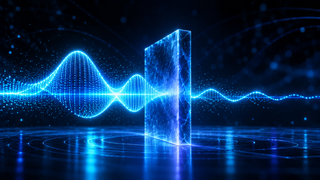
Roll a ball toward a hill without giving it enough energy to reach the top, and it rolls back. Classical physics has no exceptions to this. In quantum mechanics, a particle in the same situation has a small but real chance of turning up on the other side. This is quantum tunneling. It isn’t an exotic curiosity: it is why the Sun shines, how a flash drive remembers your files, and part of what the Nobel committee honored in 2025.
Why it happens
A quantum particle is described by a wavefunction, and the square of its magnitude gives the probability of finding the particle at a given place. Inside a barrier, where the particle’s energy E is lower than the barrier’s potential V, the wavefunction does not simply stop. It decays exponentially. If the barrier is thin enough, some amplitude is left when the wave reaches the far side, and it continues from there as a weaker traveling wave.
For a barrier that isn’t extremely thin, the transmission probability is approximately
T ≈ e^(−2κL), where κ = √(2m(V − E)) / ħ
Here L is the barrier width, m is the particle’s mass, V − E is how far the barrier rises above the particle’s energy, and ħ is the reduced Planck constant.
Light does something similar. When light is totally reflected inside a piece of glass, a faint evanescent field still leaks across the boundary. Bring a second piece of glass close enough and light crosses the gap. The mathematics is the same.
The numbers are brutal
Tunneling depends exponentially on width and on the square root of mass, which makes it extremely sensitive. Take an electron facing a barrier 1 eV above its energy:
- At 1 nm wide, the chance of crossing is about 4 in 100,000.
- At 2 nm wide, it drops to roughly one in a billion.
A proton facing the same 1 nm barrier is 1,836 times heavier, so κ is about 43 times larger, and the probability falls to around 10⁻¹⁹⁰. That is why tunneling governs electrons at the nanometer scale and is never noticed in a ball, a car, or a person.
Where it matters
Radioactive decay. In 1928, George Gamow explained alpha decay as tunneling, and Ronald Gurney and Edward Condon reached the same result independently. An alpha particle inside a nucleus is held in by a barrier it classically cannot escape, yet it leaks out with a fixed probability per unit time. Because that probability depends exponentially on the barrier, half-lives range from about 0.3 microseconds for polonium-212 to about 4.5 billion years for uranium-238, a span of more than twenty orders of magnitude.
Fusion in the Sun. The core is about 15 million kelvin, which gives a typical proton a thermal energy of roughly 1 keV. The electrical repulsion between two protons at the distance where the strong force takes over is on the order of a megaelectronvolt, about a thousand times higher. Classically, fusion would essentially never happen. Tunneling, helped by the small fraction of unusually fast protons, lets it proceed at a slow, steady rate. That slowness is why the Sun can burn for billions of years.
Seeing atoms. A scanning tunneling microscope holds a sharp metal tip about a nanometer above a surface and applies a small voltage. Electrons tunnel across the gap, and the current drops by roughly a factor of ten for every ångström the tip moves away. That sensitivity lets the instrument follow surface features smaller than a single atom. Gerd Binnig and Heinrich Rohrer built the first one at IBM in 1981 and shared the 1986 Nobel Prize in Physics.
Electronics. Flash memory stores bits by pushing electrons through a thin oxide layer onto an isolated gate, and they stay there with the power off. Tunnel diodes and Josephson junctions are built on the same effect. It also causes trouble: as transistor insulators grew thinner, electrons began leaking through them, one reason chipmakers moved to new gate materials and 3D transistor designs.
Quantum circuits. The 2025 Nobel Prize in Physics went to John Clarke, Michel Devoret and John Martinis for experiments showing that tunneling and quantized energy levels can appear in an electrical circuit big enough to hold in your hand. That work underlies today’s superconducting qubits.
What tunneling is not
It isn’t digging. The particle doesn’t carve a path through the barrier. The wavefunction extends into the forbidden region, and there is a probability of detecting the particle on the other side.
It isn’t borrowing energy. A popular shorthand says the particle “borrows” energy for a short time, as allowed by the uncertainty principle. This can mislead. In the standard treatment the particle’s energy stays the same, and the effect comes from wave behavior.
It doesn’t break relativity. Tunneling times are a subtle topic. Under some conditions the apparent delay stops growing as the barrier gets thicker, which is known as the Hartman effect. But theory and experiment both indicate that no information travels faster than light.
The takeaway
In classical physics, “can’t” means impossible. In quantum physics, “can’t” often means “extremely unlikely,” and because that probability changes exponentially with distance and mass, it can range from effectively certain to effectively never. Many of the technologies we depend on work because of this.